When I first saw the house where Man-su lives in No Other Choice, I momentarily wondered if the setting was somewhere in America in the past. The film-like color palette made it feel even more like a small-town American home from before 2000. With its spacious yard perfect for outdoor barbecues and two large dogs can run around, along with the old-fashioned brick columns and the large picture windows in the upstairs bedroom overlooking a grove of nut pine trees, the house looks unlike the typical Korean home. Yet this house, which is also one of the film's main settings, is an actual house in Neuraengi Village, located in Dogo-myeon, Asan, Chungcheongnam-do.
Director Park Chan-wook has said that Man-su and Mi-ri's house can be seen as a character in its own right, and described it as a type of house known in the 1970s as a "French-style house." Let's take a closer look at these so-called French-style houses.
French-Style Houses (佛蘭西住宅) with Nothing to Do with France
"French-style house" was a colloquial term for a type of two-story detached house that became popular in Korean cities, particularly Seoul, in the 1970s. It was not an official architectural term, but a popular nickname used at the time, and the expression has since disappeared, with such homes simply being referred to as "detached houses."
"Bulranseo," the Korean term used in "Bulranseo house," is a phonetic rendering of France, using Chinese characters for their sound—essentially a form of transliteration or phonetic borrowing. The most interesting thing is that the name and the actual architecture have virtually nothing to do with each other. These houses were, in fact, unrelated to France itself.
The prevailing view is that calling these two-story Western-style houses, characterized by their pitched triangular roofs, "French-style houses" was a branding strategy used by builders at the time. In other words, it was essentially a marketing term designed to sell the sophisticated and luxurious image of a European-style home.
However, according to architectural historian Seo Yoon-young, there is also a view that these houses may have been influenced by colonial house styles that were popular in the 19th century in places such as Indochina, which was then under British and French colonial rule, and that this style eventually made its way to Korea and came to be known as "French-style houses." Either way, there is agreement that they had nothing to do with architecture in mainland France and represented a hybrid style combining Western and Korean elements.
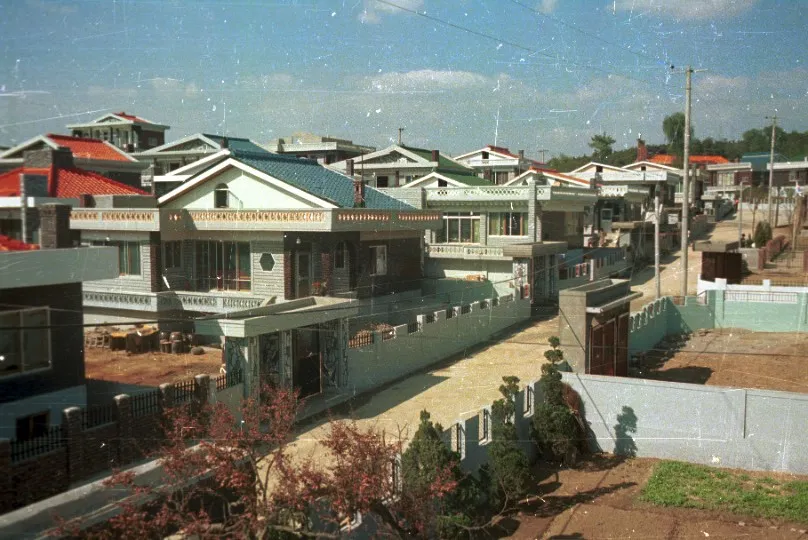 Yangji Village in Amsa-dong (1979), Source: Seoul Metropolitan Government Cultural & Public Affairs Office / Seoul Archives
The Aspirations of the Middle Class
Director Park Chan-wook has described these French-style houses as something architects looked down on at the time as a vulgar taste. Most of these homes were built in groups by small-scale builders, known in Korea as jipjangsu-jip builders, rather than by famous architects. Small construction companies mass-produced them using standardized plans.
Yet French-style houses were homes that embodied the aspirations of the middle class of that era. During Korea's explosive economic growth in the 1970s, a middle class began to emerge, and large numbers of detached houses were built, which were preferred over apartments at the time.
Just as apartments, which had the image of housing for ordinary people, were given the name "mansion" to create a more sophisticated image associated with middle-class living, private construction companies added the word "French" to detached houses aimed at people whose economic circumstances had improved, giving them the image of a dream home.
As can be seen in Man-su's house in the film, French-style houses featured balconies, terraces, bedrooms, living rooms, and Western-style kitchens. They offered modern conveniences for the 1970s, including Western-style living rather than floor-based living and indoor bathrooms.
This style spread not only throughout Seoul but also to small cities across the country. There are even records indicating that rural Saemaeul houses were influenced by French-style houses, showing that this was a trend that encompassed both urban and rural areas. In other words, the French-style house was a symbolic space that reflected, in its entirety, the middle class's aspirations for an affluent urban lifestyle and a Western-style way of living.
A House Trapped in the Glory of the Past
In No Other Choice, Man-su remains obsessed with his house even after losing his job. From the dialogue indicating that Man-su's father once operated a large-scale pig farm, we can infer that Man-su grew up relatively affluent. That is why reclaiming the house filled with memories of his childhood carries such significance for him as an adult. He believes that he cannot afford to lose the house again for economic reasons.
This house is more than simply a place to live. It is a space where Man-su's intense obsession and sense of duty as a father—to make sure his family can live in their dream home—become intertwined with deep vanity and futile effort. The house is more than 50 years old, and its grounds even contain a greenhouse, something rarely seen today. Throughout the house, where Man-su pursues bonsai as a hobby, traces of the past are everywhere.
The fact that Man-su is portrayed as a papermaker is likely connected to this as well. As redevelopment gradually causes these houses to disappear, the French-style house—with its strange mixture of a Western exterior and the harsh realities of Korean life—becomes the stage that embodies the bitter and uncanny tragedy unfolding from Man-su's obsession and desire to hold on to a past he cannot let go of.
References
- SR Times: Filming Location of No Other Choice
- Encyclopedia of Korean Folk Culture: French-Style Houses
- Jeju Peace Institute Archives: French-Style Houses
- Seo Yoon-young, Dream House, Real House