The animated film Wolf Children opens with a fantastical premise: a love story between a werewolf and a human woman. Narrated by Yuki, the elder of the two children born from that union, the film quietly traces her parents' meeting, their love, and the life her mother built alone after loss.
Hana, a university student on the outskirts of Tokyo, recognizes "him" the instant she sees him — perhaps it's simply that lonely people recognize each other. Wanting to offer a warm welcome to a man who longs for a place to call home, Hana fills their small apartment with their love for each other.
Affection Expressed Through Food
Two dishes stand in for the couple's love throughout the film: Oidare Yakitori and pheasant udon.
Oidare Yakitori (美味だれ焼き鳥)
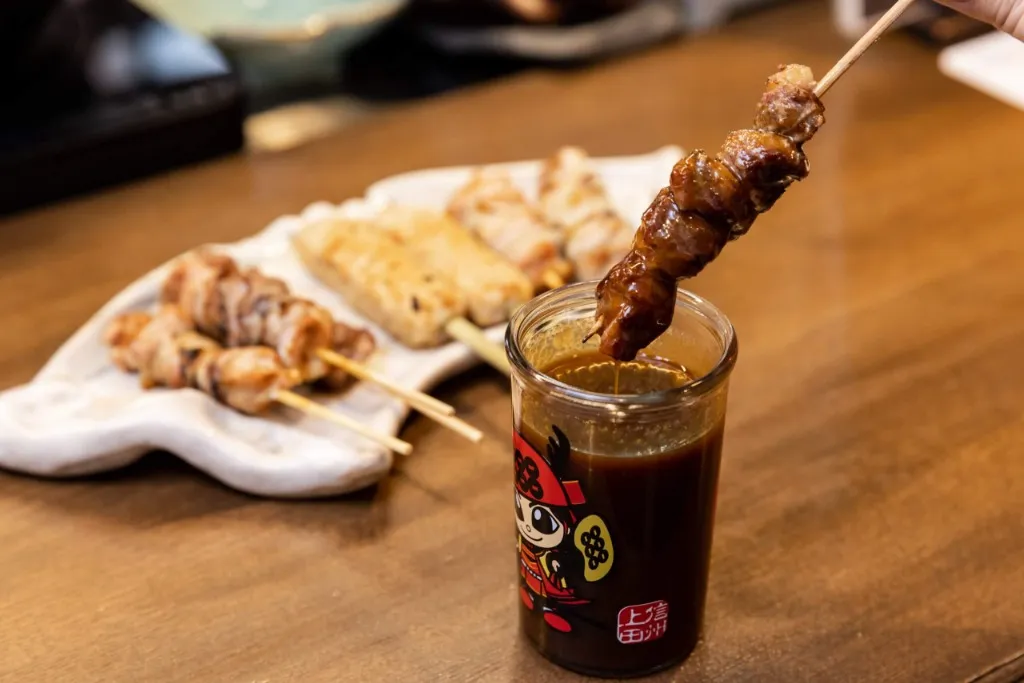 Source: Ueda Tourism Association
Oidare Yakitori, a signature local dish of Ueda City in Nagano Prefecture, is the dish Hana first serves him. He looks at it as though he has never seen such a dish before, but is visibly moved once he tastes it. Even after his tragic death, Hana often places a serving of Oidare Yakitori beside the driver's license he left behind. Yakitori typically refers to skewered meat and vegetables grilled while basted with sauce, but the version featured in Wolf Children is a little different — the skewers are grilled plain, without sauce, and then dipped deeply into a cup of sauce before eating. The word oidare (美味だれ) literally means "delicious sauce," referring to a special soy-sauce-based blend loaded with grated garlic. Residents of Ueda take enormous pride in this local specialty.
Interestingly, "oidare" is also a homophone play on a local Ueda dialect word meaning something like "you all" or "everyone," used affectionately among close acquaintances — a wordplay that lends the dish a warm, familiar meaning to locals.
It's also linked to another meaning, oidare (追いダレ), literally "additional sauce," which reflects the fact that the dish isn't served pre-dipped, but rather dipped or drizzled with more sauce according to taste, after the fact.
Either way, this Oidare Yakitori is both the dish of love Hana offers him and a dish that, like home, calls back the memory the two of them shared.
Pheasant Udon
 Source: pheasantfordinner.com
Pheasant udon is a dish he clumsily prepares when Hana, pregnant, struggles to eat. He goes out and catches a pheasant himself, then prepares the dish with great care. Hana, skeptical at first, accepts the warm bowl he offers her. Like Oidare Yakitori, pheasant udon is also a traditional Japanese regional dish — pheasant bones are used to make a broth for hot pots or noodle soups.
Traditional recipes call for crushing the bones with the back of a knife, simmering them in water over low heat for at least two hours, and then straining the broth through a fine sieve or cloth. It's a genuinely labor-intensive dish. For a man who grew up feeling like a burden at his relatives' dining tables before living entirely on his own, this must have been a daunting challenge—and it speaks to a deep devotion to his wife. Given how little money they had, catching the pheasant himself was likely the only way to get the meat at all. But this same bowl of pheasant udon also becomes the catalyst for his death. Shortly after their second child is born, he disappears without a word and is ultimately killed in an accident while in his wolf form. Beside his body lie countless pheasant feathers—his final, unrealized wish to prepare a nourishing postpartum meal for his wife, scattered to the wind.
What Food Means in Wolf Children
Beyond these two dishes that carry the couple's bittersweet love story, food comes up again and again throughout Wolf Children. Through the contrast between Yuki, a hearty eater as a child, and Ame, frail and a picky eater, the film touches on the effort Hana makes alone to feed and raise both children. Even after moving to a remote, uninhabited countryside, she reclaims rough, untended land to grow crops — both to stretch their food supply and to save money.
After both children leave the nest in their own distinct ways—Yuki to the city, Ame to the mountains—Hana, now alone, still prepares a single skewer of Oidare Yakitori for him.
The love that Wolf Children speaks of isn't some special power or fated destiny; it lives in the ordinary, everyday acts of cooking, feeding, and waiting for someone so that life can be shared. Oidare Yakitori and pheasant udon are a language of memory, standing in for their unspoken feelings. If you ever watch the film again, it is worth paying attention to the food shared throughout their brief, fairy-tale-like life together.