Synopsis
A Man follows the lawyer Kido as he investigates a man who lived under a stolen identity. As the story unfolds, Kido crosses paths with a range of people who conceal or exchange their identities to survive, and in the process, many of the characters find themselves caught in a kind of identity crisis — questioning who you are, and by extension, who they themselves are. René Magritte's painting Not to Be Reproduced, which appears within the film, functions as a symbolic device for that very confusion.
Not to Be Reproduced: The Stranger in the Mirror
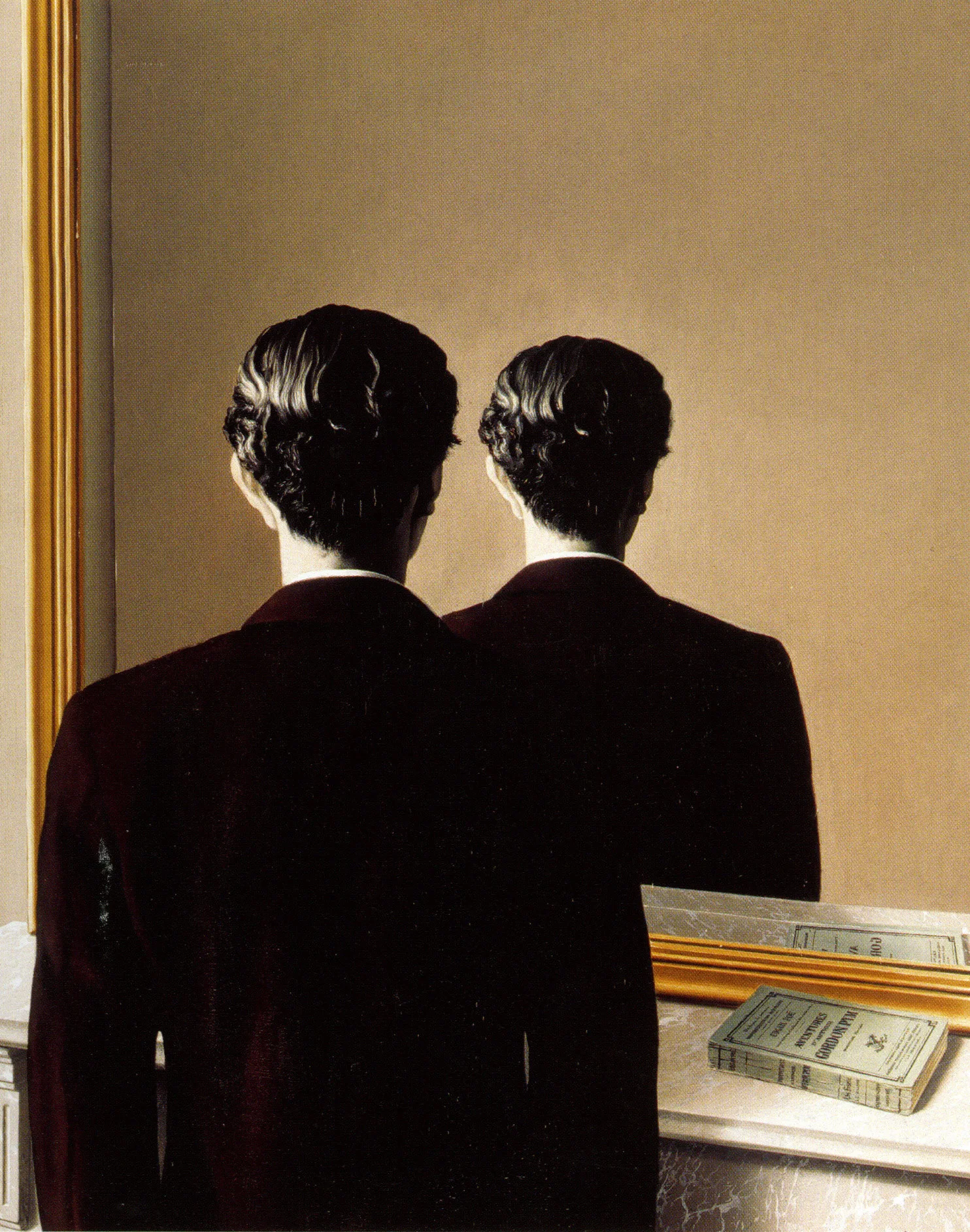
The painting in question is René Magritte's La reproduction interdite (Not to Be Reproduced, 1937). The figure reflected in the mirror defies the laws of physics: although the man standing in front of the mirror is looking into it, his reflection doesn't show a face — it shows the back of his head, exactly as it would appear from behind. The book placed in front of the mirror, on the other hand, is reflected normally, reversed as expected.
This kind of visual distortion, which defies common sense, leaves the viewer with a strange, uneasy feeling. The figure in the painting mirrors the final image of Kido, the lawyer who remains in pursuit of the mysterious man known only as 'X'.
I read it as an expression of the idea that no matter how precisely you paint a picture, it can never be reproduced like a true copy — much as how one's inner self and the way others perceive that self are never quite the same thing. It can also be read as a statement that, unlike objects, the complexity of a human interior can never be measured or drawn out identically by anyone, no matter how carefully they try.
The Indelible Stigma
Japan's Ministry of Justice defines "hate speech" as one-sided rhetoric aimed at ostracizing individuals from Japanese society or causing them harm, solely because of their national origin or ancestry. This stems from a long-standing culture of collectivism that places heavy emphasis on lineage and belonging — a backdrop against which discrimination and suppression based on one's origins have persisted. Discrimination against Zainichi Koreans — ethnic Koreans residing in Japan — has even been the subject of an official report by the UN Committee on the Elimination of Racial Discrimination.
The lawyer Kido is a third-generation Zainichi Korean. While investigating X's true identity, he's met not only with a mocking remark — "You're third-generation, aren't you?" — from a con man he interviews, but also with his own father-in-law openly defending far-right demonstrations in Japan, right in front of him. Kido doesn't push back. The scene reads as a portrait of just how difficult it is to shed the label of one's origins in Japanese society.
X, meanwhile, is the son of a murderer. Japanese society is deeply shaped by the culture of meiwaku (迷惑) — a strong social aversion to causing trouble or burden for others. Within this collectivist atmosphere, cases in which even the families of criminals come to bear social stigma have been repeatedly documented.
There's no official system of collective punishment in Japan, but the shunning and isolation these families face can be severe, and "net lynching" — public pile-ons enabled by the internet — has emerged as a serious social problem.
X was only a child when his father committed the crime, yet the label clung to him regardless of his age. The only way for him to live as himself, rather than as "the criminal's son," was to abandon his name entirely and live somewhere no one knew him.
The Self-Portrait Behind the Name
Overcoming an origin that society treats as an inescapable, almost fated part of who you are is no easy task. Beyond the family of a criminal and a Zainichi Korean, there's a third figure in the story: the real owner of the identity X borrowed, who also gave up an ordinary, comfortable life and traded away his name — likely because he didn't want to live under a name that, the moment people heard it, would mark him as the son of some hot-springs-inn family. No one has the right to stop someone who sets out on a journey to find their true self, shedding a burden they were saddled with from birth.
Rewriting the Hidden Self
It's unlikely that the lawyer Kido will ever give up his profession or his name. Even with a father-in-law who makes no effort to hide his contempt and prejudice, that family's reflected status — its wealth and power — has shaped Kido's own life all the same. But in some small bar where nobody knows his name, he can, if only for a moment, speak a false name — or the name and life he actually wishes for — as though it were his real one. As Magritte's painting suggests, the life we construct for ourselves is never quite the same as the one we're living now, and it can never be reproduced identically, either.