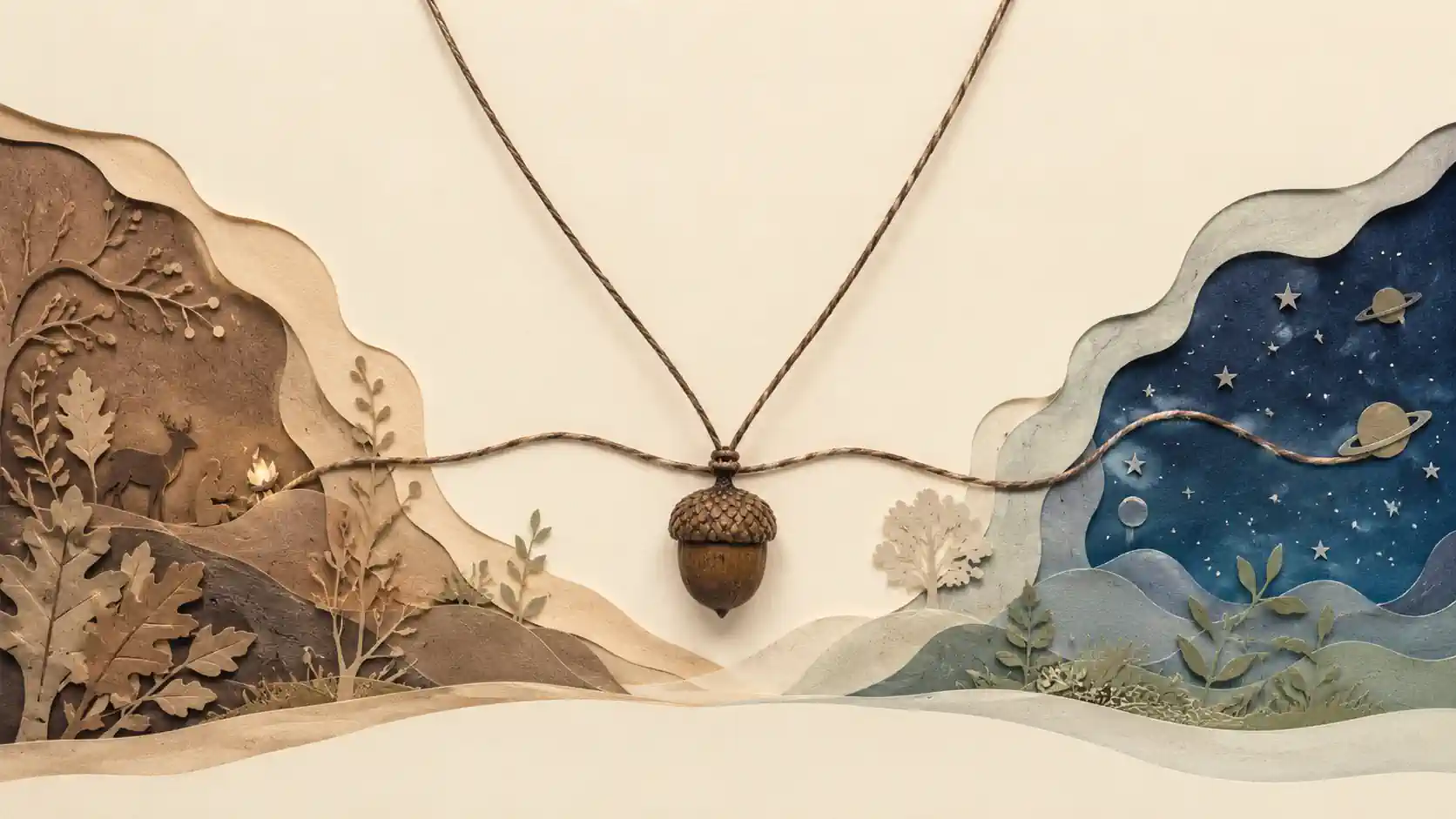
What lingered with me most from In the Blink of an Eye was a small acorn necklace. Passed down from mother to daughter in a prehistoric family, it crosses time and eventually reaches Koklea, a character living in the distant future. Rather than settling for the obvious statement that memory carries on across generations, the film gives that idea weight by turning it into something you can literally hold in your hand. And it was at that very moment that a single line from early in the film came back to me.
In the Blink of an Eye weaves tens of thousands of years into a single story across a runtime of roughly 90 minutes. Three timelines intersect throughout:
- Prehistory — the story of a family
- The present — the anthropologist Claire
- The future — Coakley, voyaging through space in search of a new home
These feel like stories from entirely different eras, but as the film moves toward its later half, they converge into a single thread: birth, death, and memory. At the center of that thread is a single message — that even as individuals disappear, memory continues.
As the starting point of that thread, the film quotes a line early on:
"Remember, remember this is now and now and now…"
Sylvia Plath's Journal
This line comes from The Unabridged Journals of Sylvia Plath, published after the American poet's death. Beyond the portion quoted in the film, the original passage continues:
Live it, feel it, cling to it. I want to become acutely aware of all I've taken for granted.
Where Sylvia and the Film Meet
I don't think the film borrows this line simply because the women representing its three eras share a gender with the poet who wrote it; rather, I believe it's because of the attitude embedded in the words themselves. When we reflect on the life of Sylvia Plath, who took her own life at the early age of thirty, the cry in her journal to "cling to this moment" resonates as more than a simple resolution—it becomes a fierce urgency born from the finitude of life. Paradoxically, this urgency, which shines all the brighter because it is finite, aligns deeply with the attitude of Claire in the film, who rejects eternal life in favor of a fleeting existence.
Claire and her husband turn down eternal life. They already understand something the rest of the story circles back to: that living now matters more than living long, that life carries forward through one's children, and that a moment becomes more urgent and more meaningful precisely because it's limited.
The memories of raising a child — the laughter, the tears — are fleeting in themselves, and yet Claire comes to realize they stretch endlessly into both the past and the future.
It's the same logic, in the end, that leads most of humanity to give up immortality generations later, leaving only Coakley — the one person granted a long lifespan — to carry countless embryos across the stars in search of a new planet.
Even for those of us living in an age where a hundred-year lifespan is the norm, time remains finite — and that's precisely what gives it meaning. These moments may pass in the blink of an eye, but perhaps it's this very moment, right now, that lasts forever. It is much like the acorn necklace in the film that crosses tens of thousands of years into eternity—just like the fleeting "now" that Sylvia Plath struggled so desperately to become acutely aware of.