The protagonist of Zom 100: Bucket List of the Dead, Akira Tendo, is a third-year employee who has been physically and mentally drained by a ruthless company. One morning, a zombie pandemic breaks out across the city, and what Akira feels in that moment is not fear, but liberation. Simply knowing that he no longer has to go to work, he begins writing down 100 things he wants to do before he dies.
What is interesting about this anime is not the zombies themselves. The moment the zombie outbreak is portrayed not as a disaster but as a form of liberation, it reveals what kind of company Akira had been working for. There is one term used to describe it in the story: a black company, or burakku kigyō.
What, then, is a black company? The term was not coined for the anime. In Japan, "black company" has been used for many years, and tracing its history helps explain why someone like Akira could actually welcome a zombie outbreak.
 ©麻生羽呂・高田康太郎・小学館/「ゾン100」製作委員会
From Internet Slang to a Mainstream Term
The term black company (ブラック企業) was originally slang for illegal businesses associated with antisocial groups such as organized crime. It evolved into its current meaning—a company with harsh working conditions—around 2000, on Japan's major anonymous online message board 2channel (2ちゃんねる).
Job seekers began using the term while sharing so-called "companies you should never work for" lists. At first, it was closer to self-deprecating slang used by programmers in the IT industry, where overnight work and long hours were common.
The term entered the mainstream consciousness in 2007, when a post titled "I Work for a Black Company, and I Think I May Have Reached My Limit" (ブラック会社に勤めてるんだが、もう俺は限界かもしれない) appeared on the same message board.
The post described the brutal working conditions experienced by a young man with almost no previous employment history who had finally managed to get a job at an IT company. It was published as a book in 2008 and adapted into a film in 2009. This marked the point when "black company," once merely internet slang, became a popular concept with a story of its own.
Then, in 2013, "black company" was named among the Top 10 New and Trending Words of the year in the annual U-Can New Words and Buzzwords Awards. A term that had begun as a self-deprecating joke on an anonymous message board had, within six years, become a socially recognized expression that represented the year.
How the Japanese Government Defines a Black Company
As the new term spread like a trend and began to generate broader social debate, an NGO, lawyers, and journalists came together in 2012 to establish the Black Company Awards (ブラック企業大賞), an annual award recognizing companies accused of particularly severe exploitation of workers that year.
The criteria used for the awards are quite specific. They are based on cases actually recognized by labor authorities, including whether an employee's death was officially recognized as death from overwork, the amount of unpaid overtime wages, and the number of officially recognized workplace accidents.
Even Japan's Ministry of Health, Labour and Welfare could not ignore the issue. On its "Check Your Working Conditions" website, the ministry addresses the question, "What can a company do to avoid being called a black company?" While the government does not officially define "black company" as a formal term, it identifies the following as common characteristics:
① Imposing extremely long working hours or excessive targets on employees;
② Having a low level of corporate compliance, to the point where unpaid overtime and workplace harassment (power harassment) are widespread; and
③ High turnover driven by treating workers as disposable under such conditions.
The term had already entered the realm of public administration to the point that a government agency was citing the characteristics of what had originally been internet slang in its official materials.
One company that repeatedly appeared on such lists was the advertising agency Dentsu, which ultimately received the 2016 Black Company Award following the overwork-related suicide of a young employee.
At Dentsu, two deaths occurring 24 years apart—in 1991 and 2015—were officially recognized as occupational accidents involving the same pattern of overwork. Often referred to as the "first Dentsu case" and the "second Dentsu case," these incidents were just two of many cases showing that the term "black company" was not merely a metaphor, but referred to workplaces where people were actually dying.
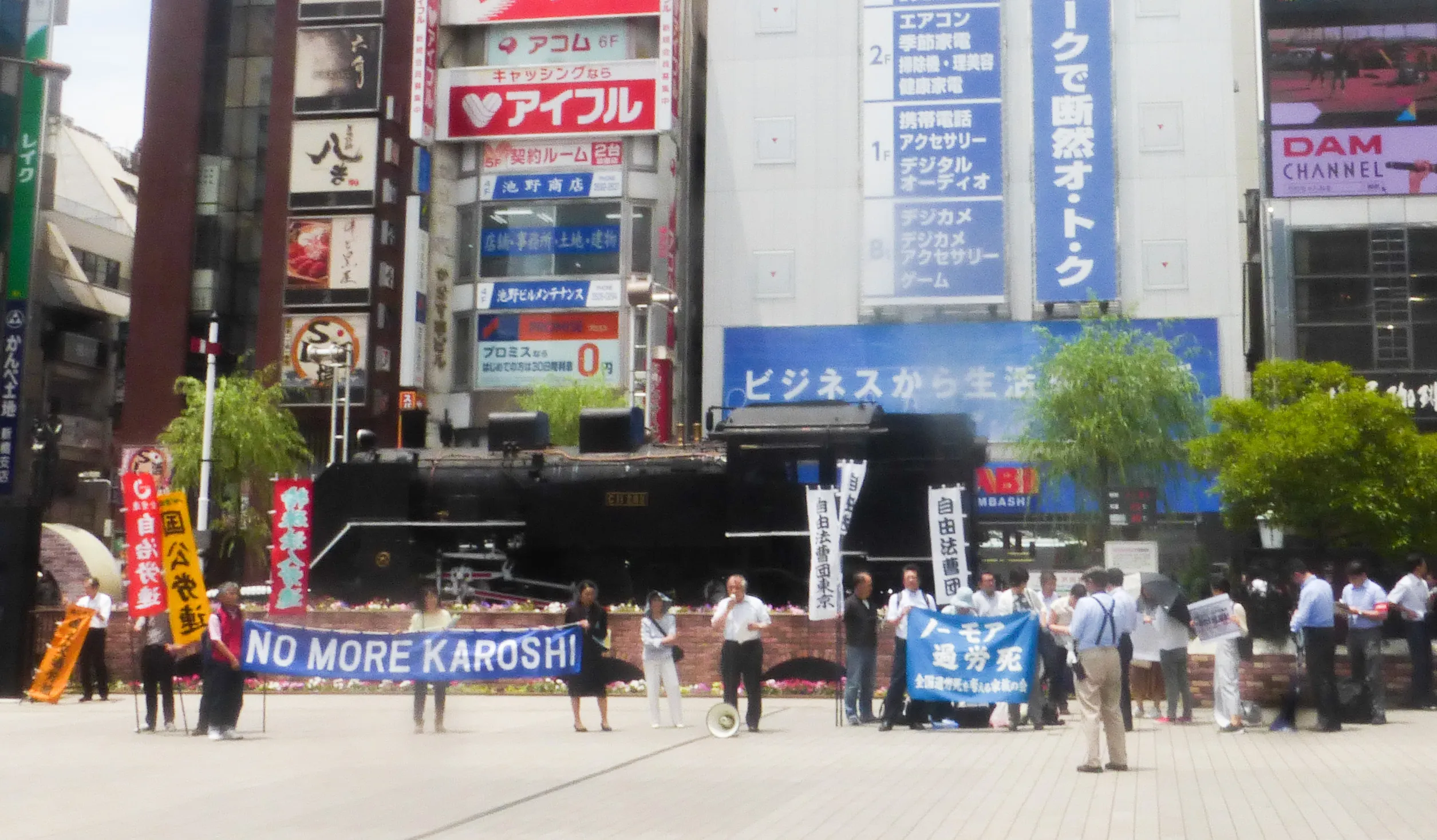 Nesnad, CC BY-SA 4.0
Karoshi — A Word That Made Its Way into the Oxford English Dictionary
And at the end of this entire process, there is one word that crossed borders almost unchanged in pronunciation: karoshi (過労死), meaning death from overwork.
According to the Oxford English Dictionary (OED), the noun karoshi was first added to the dictionary in December 2001, with its earliest recorded usage tracing back to a 1988 Chicago Tribune article. The dictionary classifies the word as a loanword from the Japanese karō-shi, and gives both British and American pronunciations as "kuh-ROH-shee," preserving the Japanese pronunciation.
When a foreign word is incorporated into another language without being translated, there is usually a reason. The receiving language did not have an equivalent concept.
The fact that English speakers had to borrow the Japanese word itself to describe the phenomenon of dying from overwork suggests just how far this entire progression had gone: from internet slang to a buzzword, from a buzzword to a term referenced in government materials, and finally to an entry in a foreign-language dictionary—proof that this unfolding social tragedy was anything but an exaggeration.
Akira's feeling of liberation rather than fear in the face of the zombie outbreak is not simply a cartoonish fantasy. After spending days at work without even going home or taking a shower, his mind slowly breaking down until he begins to resemble a zombie himself, going to work has become more frightening to Akira than death.
His gray, monotonous daily life suddenly turns into a world of vivid colors when the zombie outbreak begins. The irony is portrayed through scenes of Akira cheerfully cleaning his filthy apartment—too exhausted from working through the night to even take out the trash—while humming to himself and writing down his bucket list, gradually coming back to life.
Akira was a worker who was alive, yet somehow no longer living. One cannot help but hope that the bucket list he wrote down will, at least in this paradoxical zombie world, come fully true.
References
- Japan Ministry of Health, Labour and Welfare, "What is a 'Black Company'?", Check Your Working Conditions (確かめよう労働条件)
- "I Work for a Black Company, and I Think I May Have Reached My Limit", Wikipedia (Japanese)
- Black Company Awards Official Site, "Black Company Awards 2016" Nominees
- ITmedia NEWS, "2013 Buzzword of the Year: 'Now, isn't it!', 'Je je je', and more — 'Black Company' also makes Top 10" (December 2, 2013)
- Oxford English Dictionary, "karoshi, n."